



I want to introduce you to Andy Tudor. He’s an illustrator. And a good one too. If you’ve ever raised children, then his artwork has probably graced a few of the cherished Usborne books in their toybox. His designs extend to other products too, jigsaws, stickers, posters, infographics, lots of fun, playful stuff. And Andy is my special guest today.
Welcome to the Design Intelligence Substack from Digital Producer Paul Fillingham. Sound design by Studio-thinkamigo. It’s here where we discuss the highs and lows of the creative process, from the very latest developments in AI-assisted design to digital storytelling in ‘Houdini Window’. This Substack is narrated in the voice of Paul Fillingham
Andy Tudor was responsible for the cover illustration for our Award-winning digital comic Dawn of the Unread. The artwork depicts Nottinghamshire as a sandstone mountain, or was it a giant birthday cake to celebrate our rebel writers? Here, Nottingham’s Castle-rock is surrounded by cartoons of literary figures in their respective haunts; the streets, the houses, the mansions and in some cases tunnels.
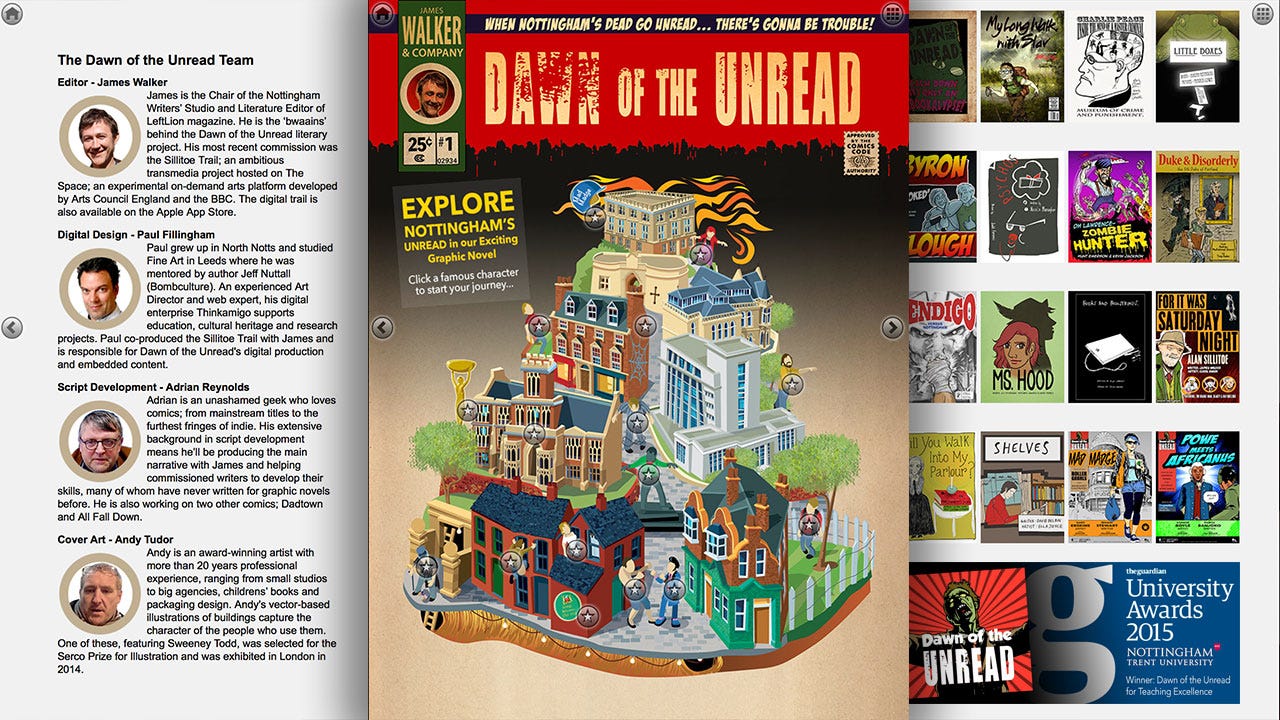
I adapted the artwork as a user interface for the Dawn of the Unread homepage and that linked to all of the digital comics - there were sixteen in total. And two of those comics featured Welbeck Abbey which is the setting for today’s chinwag.
Spaghetti Hoops
Andy and I are both miners’ sons from North Notts, which is a world away from the (big) City of Nottingham. We’re Robin Hood’s men, living in the land of the barons, the forests and grand estates at the very northern tip of the county. As you might guess, the Dukeries are part of Sherwood Forest, where Nottinghamshire intersects Derbyshire and South Yorkshire. It’s ‘Ayup youth’ more than ‘Ayup mi duck,’ spoken with a guttural, almost Germanic tone.
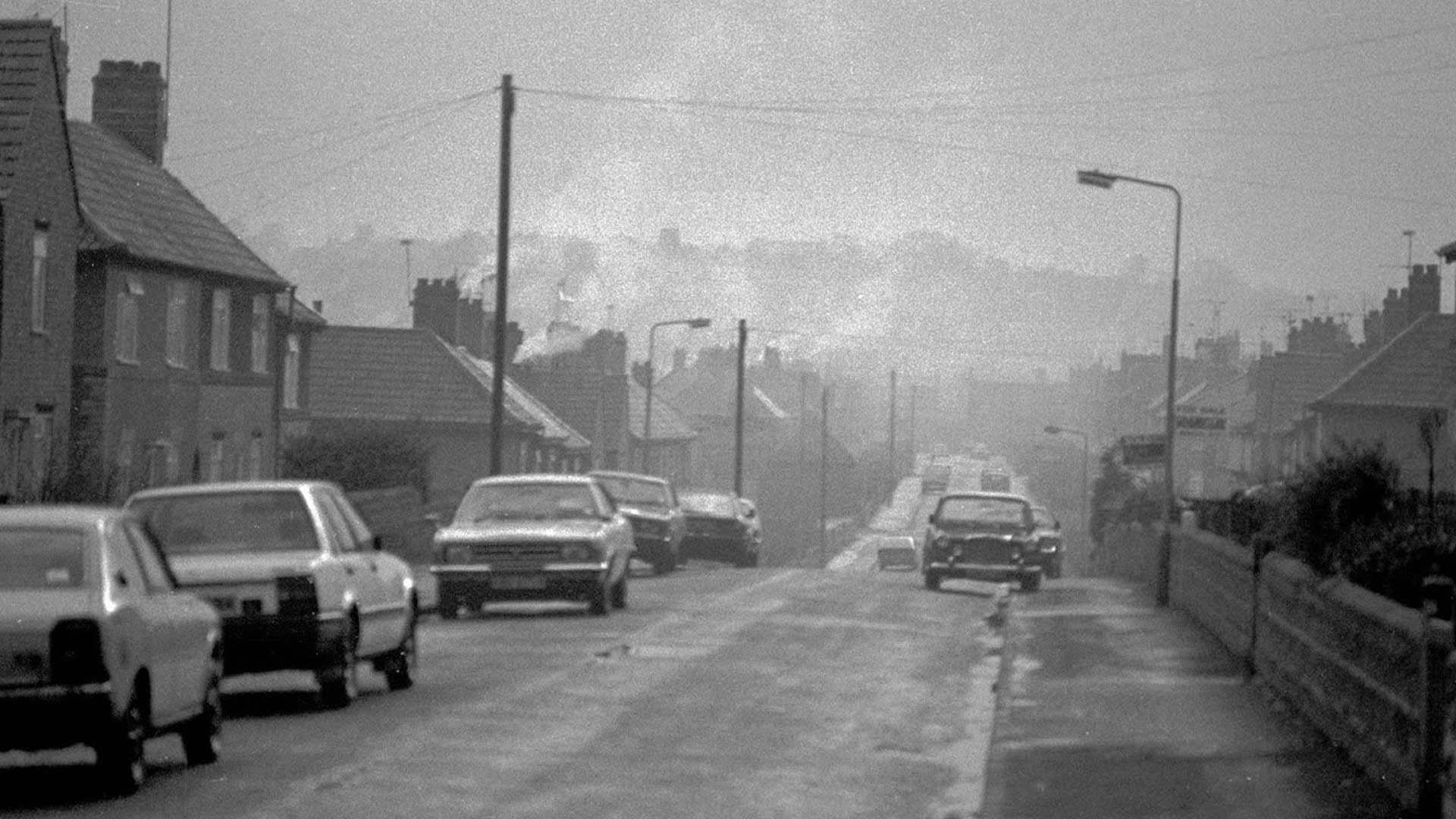
We share the experience of growing up in model villages, originally built by mining companies for their workers in the 1920s. Both of us were destined to work down the pit, but somehow escaped. I fled to Leeds, Andy to Chesterfield, where pit talk was augmented with descriptive words demanded by the visual arts. At art school we worked alongside middle-class kids who ate real spaghetti rather than the orange stuff that came out of a tin. We were given gentle encouragement from worldly teachers and eccentric lecturers who recognised our calling.
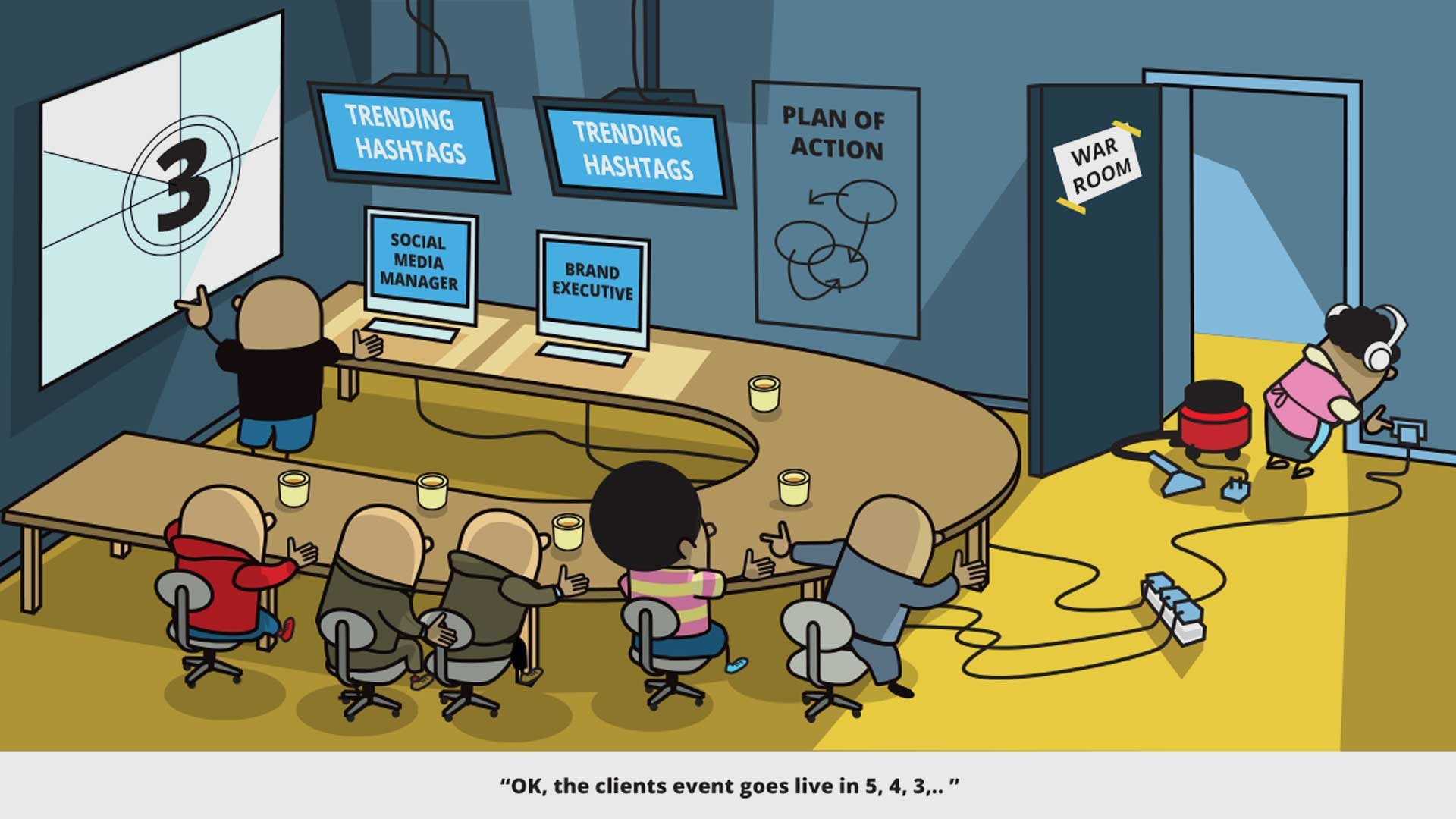
Andy’s work evokes a whimsical world where even inanimate objects, vehicles, buildings, become living, breathing personalities in their own right. You can recognise one of his drawings instantly.
By contrast, my own work was shaped by fine art practice at Leeds Poly - then called ‘mixed media.’ But would likely be called ‘multidisciplinary art practice’ today. Essentially it’s cut-up, it’s collage visuals augmented with words, audio, and live performance. We didn’t think twice about swapping a paintbrush for a tape loop. ‘Experience mediated through technology,’ to borrow a phrase from the artist and musician Laurie Anderson.
God’s Trumpet
Following hot on the heels of Dawn of the Unread, our next collaboration was an e-Learning platform called Clarion. And this explored Jericho - a science fiction story by Andy and Adrian, designed to enourage user-generated content. We teamed up with Henderson Mullin from Writing East Midlands and Dr Sally Maynard from the Department of English & Drama, at Loughborough University – people who could unlock funding for the platform and provide a ready-made audience for our ideas and prototypes - or so we thought. Sadly, the (NESTA) bid didn’t land - there were more worthy concepts than the one cooked up by this ragbag assembly from the East Midlands.
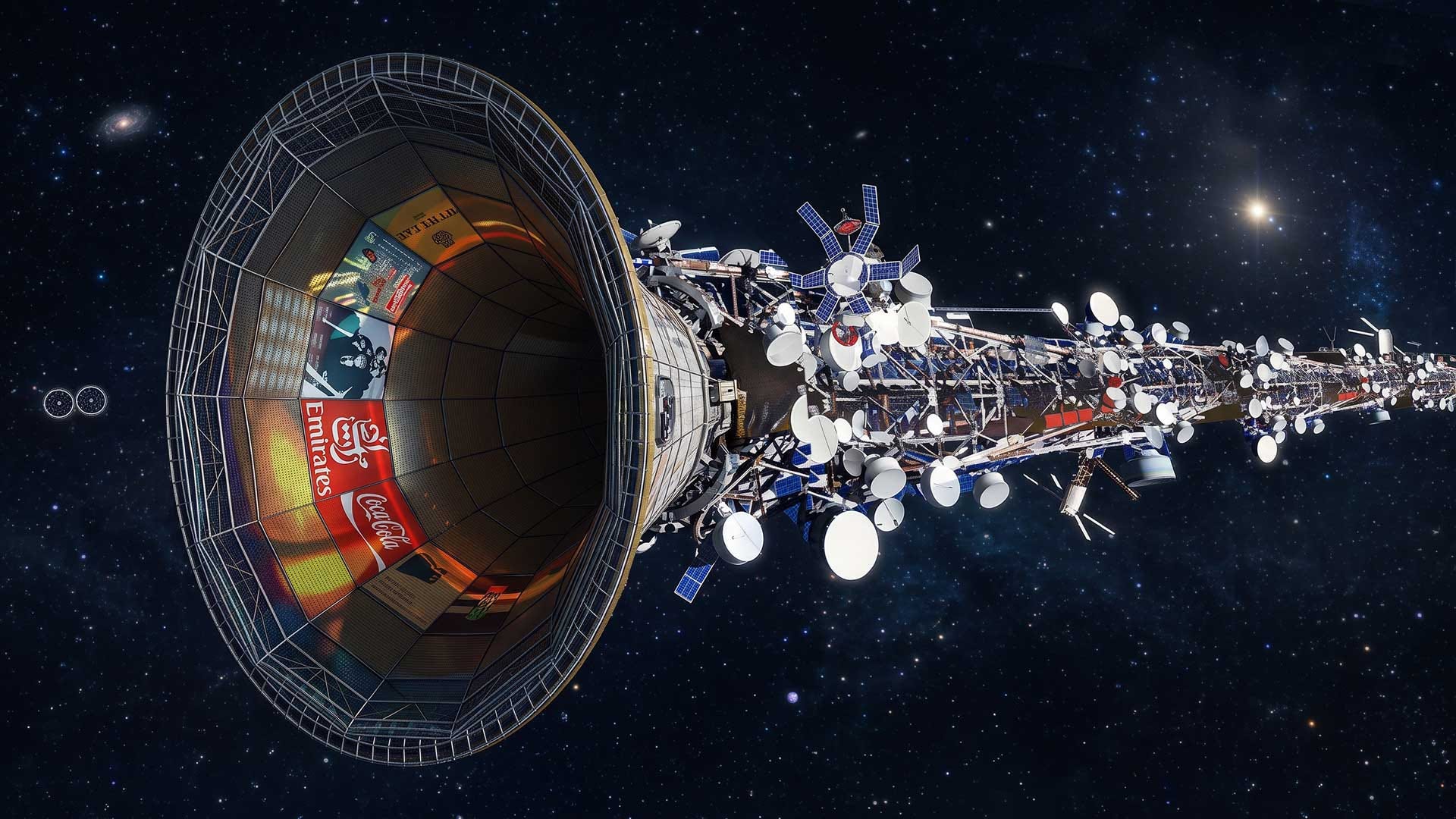
Jericho was a great little story, involving different cohorts living in nomadic space colonies, mining the moon for rare minerals and transporting them back to earth. Instead of disconnected ground and orbital space stations we imagined a continuous orbiting superhighway, Two-Hundred and Forty-Thousand miles in length bridging the Moon and the Earth. This giant orbiting structure would allow the movement of independent prospectors in a kind of Klondike gold rush, with space communities developing around the watering holes and the eateries along the way - each with their own story to tell. The structure would have a funnel at both ends, and it would be visible from the earth in the night sky. I figured this giant structure would become known as ‘God’s Trumpet’, and travelling along it for some, would be a lifelong pilgrimage.
Ice Age Explorers
Our next collaboration was around ten years ago. I was working with the visitor centre at Creswell Crags; the limestone gorge and caves located on the Notts, Derbyshire border, famous for prehistoric cave art, tools and fossilised animals. I was running some creative workshops there, involving volunteers and schoolchildren, with the objective of co-creating an Ice Age app. One of these sessions was delivered jointly alongside Mansfield Museum curator, Jodie Henshaw. The other, I delivered at Netherthorpe Academy in Derbyshire.
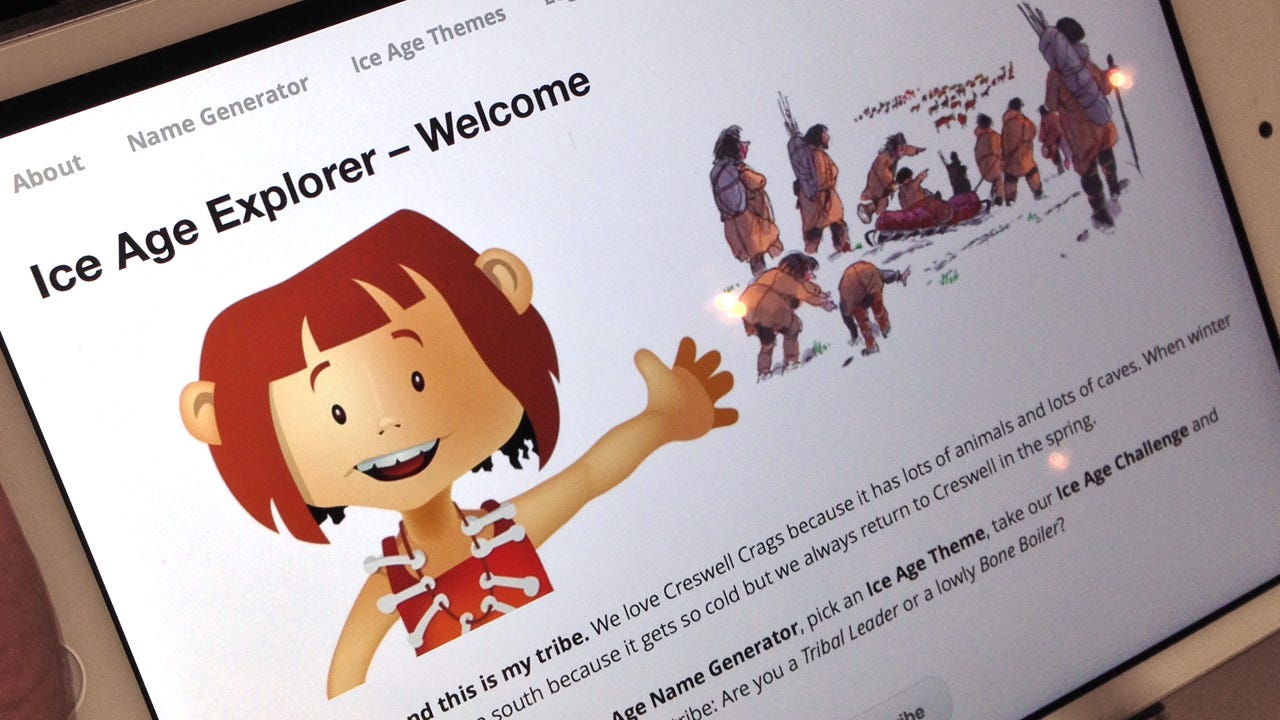
Then came the opportunity to produce a real version as a web-app that could run on tablet devices in the visitor centre. I needed a cave girl character who would appeal to young children. We called her Una, and Andy was just the person to bring her to life.
I included other illustrations too, some by the famous cartoonist, writer and television personality, Bill Tidy (MBE). His drawings had been languishing in the archives at Creswell: Tiny images of Neanderthals dressed in furs, hunting animals with spears or huddled around fires. Creswell was once the most northerly spot where humans and animals could survive at the time of the Ice age.
Creswell sits between the former mining communities of Clowne and Welbeck. My grandfather Tom Wass worked at Clowne colliery and my grandmother, Sally was a servant at Welbeck Abbey, which is where Andy and I had arranged to meet for our chinwag.
The Dukeries
In the 17th and 18th century, Charles II and Queen Anne sold large areas of Sherwood Crown Land to wealthy individuals. And they built the estates of Thoresby Hall, Clumber House, Welbeck Abbey and Worksop Manor, they established what came to be known as The Dukeries (Wikipedia). And in modern times sold the mineral rights of their estates to commercial mining companies. The Portland family at Welbeck used their wealth - based on land, horses and coal to build their vast collection of books, paintings and decorative arts.
The Welbeck Estate is a cultural treasure, nestling between lush green trees and open fields. Today, it boasts a School of Artisan Food, cafés, working arts studios, a garden centre, farm shop, The Harley Gallery, and Portland collection. The quality and content of these galleries is world-class. Welbeck is a magnet for those lucky enough to know about its existence. Andy and I have met here before, but that was years ago and today’s chinwag was well overdue.
Andy’s professional SLR camera seemed strangely conspicuous as we walked through the restored conservatories in the Abbey grounds in search of drinks, pastries and a place to talk. In the past, most art students would have been equipped with a Zenith-E or an Olympus 10 camera. Now of course the ubiquitous iPhone is king.
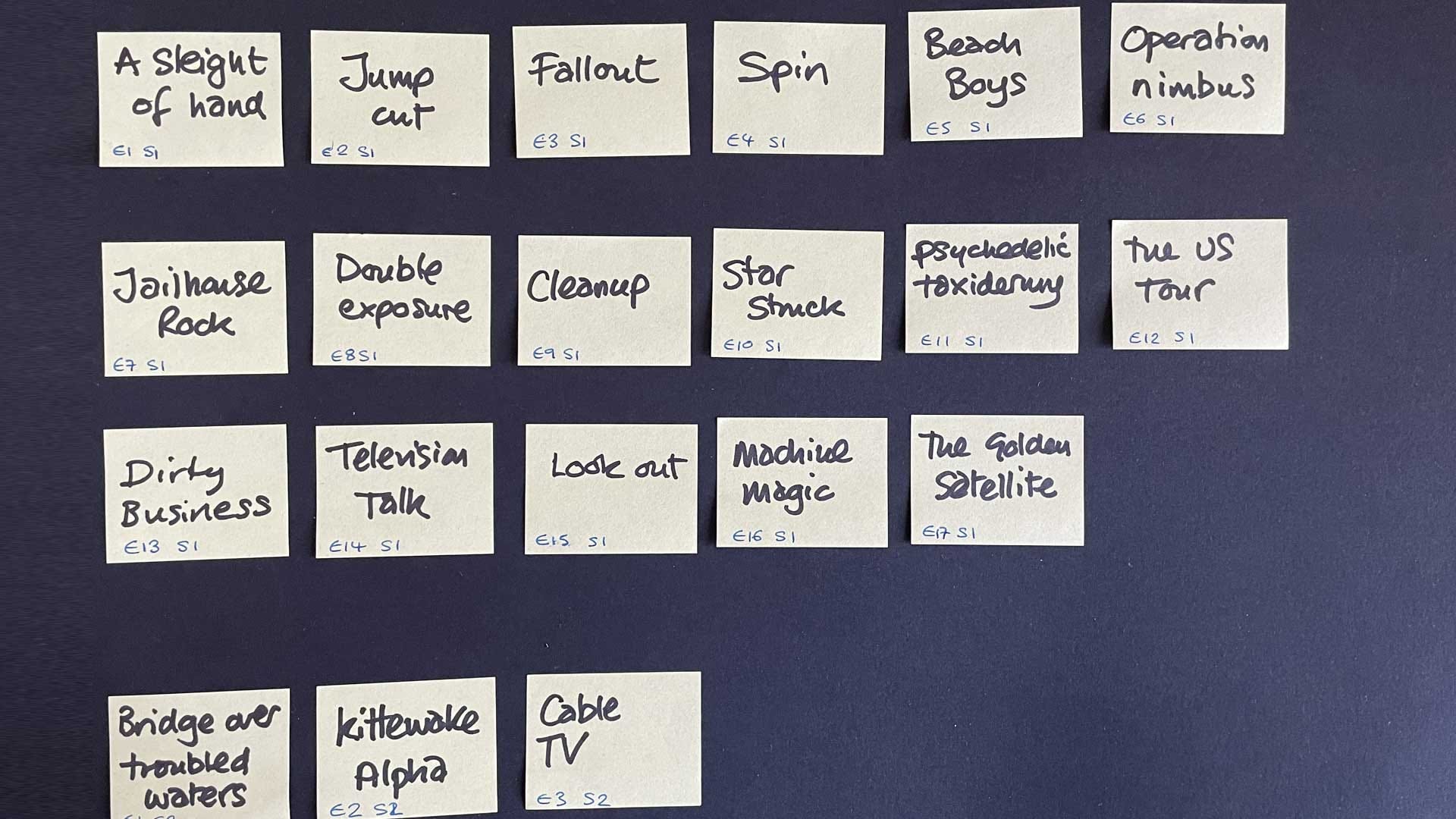
Having completed the episode outline for Houdini Window the previous evening, Andy would be the first person to hear the story from beginning to end. And given his sci-fi credentials, I valued his feedback.
Ready Set Go
Conversation strayed into aspects of design practice - the way things have changed over the years, the feast or famine of freelance work, and how the software tools we used to own are now rented.
Inevitably, we talked about AI. You would expect an illustrator to be threatened by AI, but that wasn’t the case. By his own admission, he’s always been an early adopter: The Macs in the eighties, desktop-repro in the 90’s, and a mastery of Postscript spline curves and typography which began with Letraset’s Ready Set Go and is now largely produced with Adobe InDesign.
Branding, Briefs and AI Bundles
It was time to share my knowledge of using AI, more specifically Claude. And the practice of pre-loading the AI chat window with bundles of information and sketches, before even thinking about typing a prompt.
I described how these bundles comprise of a document to describe a client’s brand values, another that describes the business model, another for the visual style including colours and fonts, and then crucially, a document which describes your own stylistic preferences, case studies and portfolio.
Andy couldn’t get his phone out quick enough to record what I was telling him.
For my own work, these bundles extend to describing web frameworks as well; the HTML, the CSS, and the JavaScript libraries. But with Andy being a more traditional graphics, I figured he wouldn’t need the coding bundles just yet. I mentioned Obsidian too, as a main authoring tool that allows you to write the markdown (.md ) text files that AI models can easily digest.
Design Deliberation
When I mentioned the fact that the draft for Houdini Window had been abandoned for years, Andy spoke about the value of downtime when you allow an idea to mature in your own mind, before picking it up again. This is something I call ‘design deliberation.’ In a court of law, the judge and jury will often retire to deliberate before the final verdict. And design deliberation is exactly like that.
A few weeks back I tried to give Claude an understanding of deliberation. But because the model is trained on historic data and cached web content, Claude ‘confessed to not being able to use ‘time and date.’ in any meaningful way.
I asked several times for Claude to give me the right time and date and each time it failed. This was a shocking discovery telling the time is a basic skill for humans. But I figured the server on which the service was hosted must have an internal clock. So, I told Claude to write a script to check the internal clock of the computer it’s sitting on and then make the necessary time (zone) adjustment for British Summer Time. Since then, Claude has routinely noted the time and date at the start of every session and the length of time since our last session ended.
Claude now ‘understands’ that the length of deliberation may affect past and future design decisions in the next session. Combined with document versioning and change-logs, this is a valuable AI design skill.
But Claude wasn’t the only one ‘watching the clock’. Previous chinwags have shown that hours can flash-by like minutes. And not wanting to to miss an opportunity of wandering through the Portland Collection, we set off across the estate to the gallery.
Winifred, Margaret and a King’s Earring
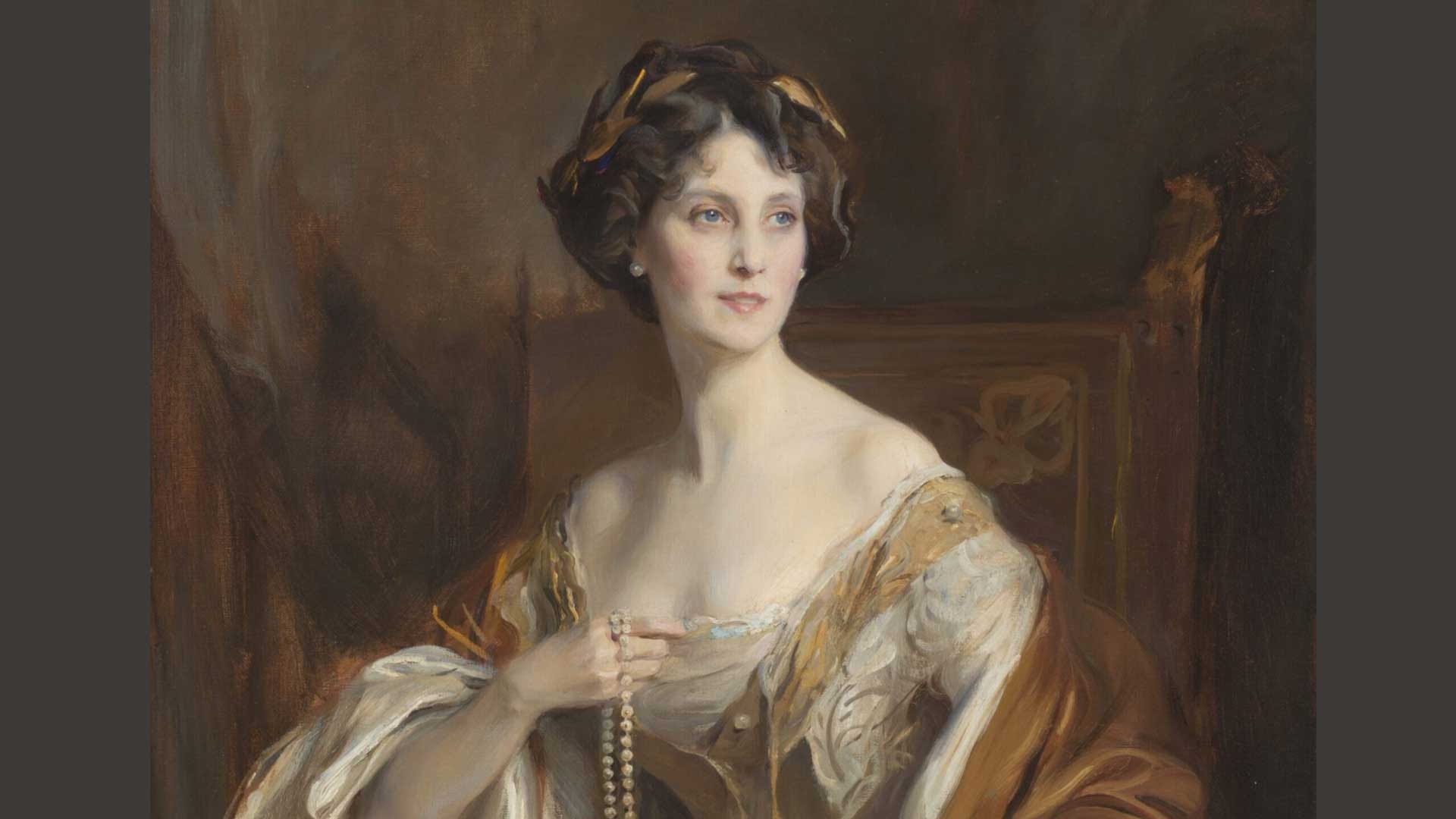
Prior to our visit, Andy had emailed a stunning painting from the collection, a portrait of Winifred Anna Cavendish-Bentinck, Duchess of Portland, painted by Philip Alexius de László in 1912. Winifred was the first president of the Royal Society for the Protection of Birds. An important detail in the painting is a necklace that she’s holding in her right hand. Jewellery has a special significance in this place.
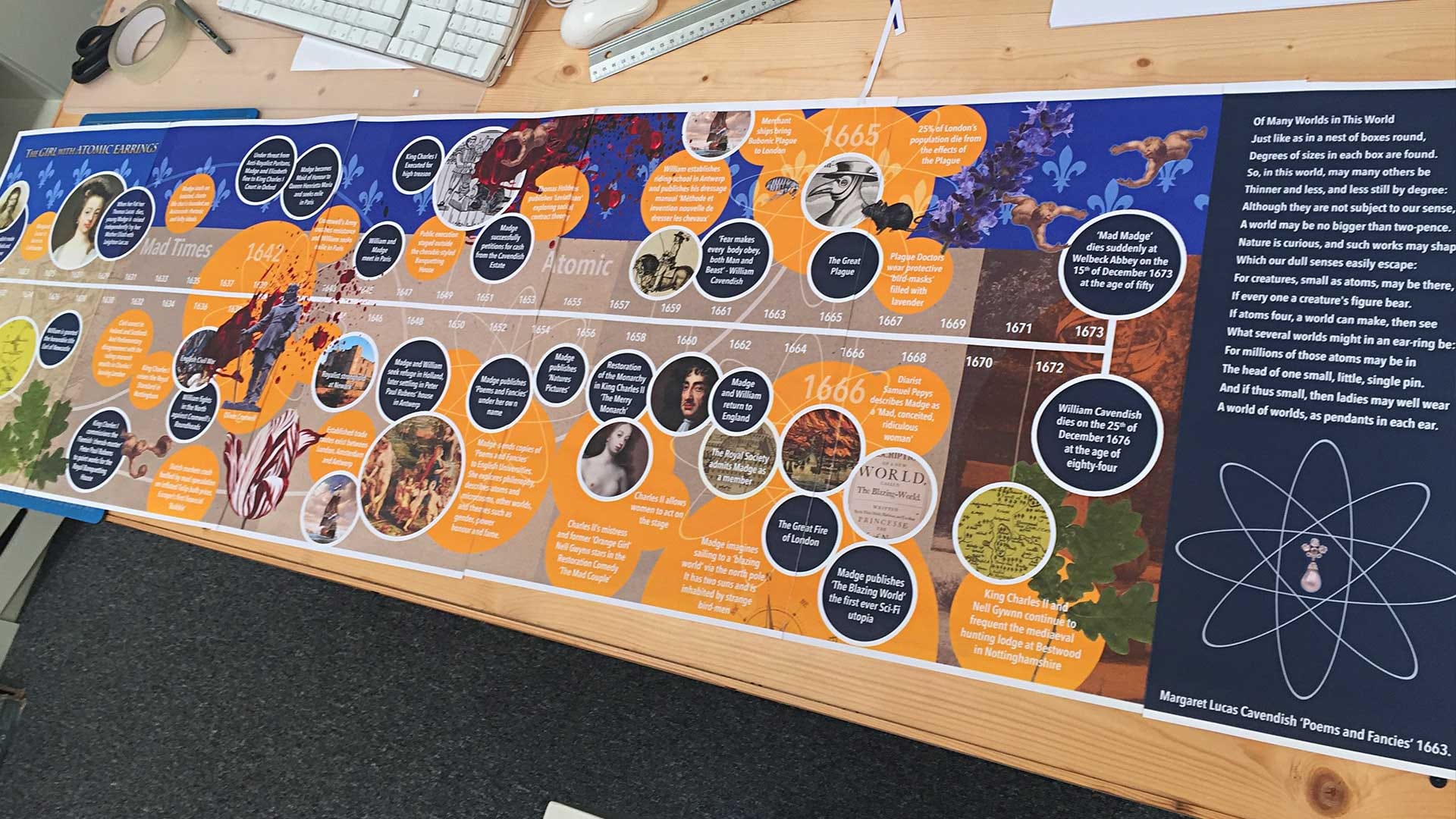
In an infographic for Dawn of the Unread, I chose to focus on an earring that featured in Poems and Fancies, which was published by Welbeck’s Margaret Lucas Cavendish in 1653. ‘Mad Madge’ as she was called by diarist Samuel Pepys, was also responsible for The Blazing World. Published in 1666, Blazing World is often considered the first utopian science fiction novel.
The title of my infographic was Atomic Earrings and also features Margaret’s poem.
Just like as in a nest of boxes round,
Degrees of sizes in each box are found:
So, in this world, may many others be
Thinner and less, and less still by degree:
Although they are not subject to our sense,
A world may be no bigger than two-pence.
Nature is curious, and such works may shape,
Which our dull senses easily escape:
For creatures, small as atoms, may be there,
If every one a creature’s figure bear.
If atoms four, a world can make, then see
What several worlds might in an earring be:
For millions of those atoms may be in
The head of one small, little, single pin.
And if thus small, then ladies may well wear
A world of worlds, as pendants in each ear.Margaret Lucas Cavendish 1653.
All this talk of earrings was too much for a vigilant gallery assistant who could barely contain himself. He led us to the glass case containing a single pearl earring that once belonged to King Charles I - an earring that he was wearing when he was beheaded in 1649.
The next piece of jewellery on the agenda was Winifred’s £3.75M diamond tiara. Missing from its display case with just a flat illustration in its place. The real deal had made an unscheduled trip to Turkey after a daring midnight heist by jewellery thieves in 2018, who, according to our guide, ‘were armed with chainsaws, and a gun’
The gallery assistant introduced himself as an ‘ex-cop’ and described the chain of events; how the robbers performed an inspired recce using a GoPro camera mounted on a wheelchair, and then one year later, broke into the gallery and made off with the tiara. This ended up in a London jeweller’s before its trip overseas. The gang were eventually caught, and the GoPro and CCTV footage are still available on YouTube. The whereabouts and condition of the tiara are unknown.
The three of us discussed whether Madge’s Atomic Earring might actually be a direct reference to the iconic pearl that once belonged to Charles I. But time was pressing on, no conclusion was found, our chinwag was coming to an end. But not before one last encounter with László’s exquisite painting of Winifred.
I later discovered that Winifred ‘cared greatly for the local miners and supported them by paying for medical treatments, and organising cooking and sewing classes for their daughters. She also sponsored a miner, with an interest in art, to study in London.’ In honour of her support, the Nottinghamshire Miners’ Welfare Association petitioned the King on her behalf; and in 1935 she was made a Dame Commander of the Order of the British Empire (DBE).
A Technicolor Epilogue
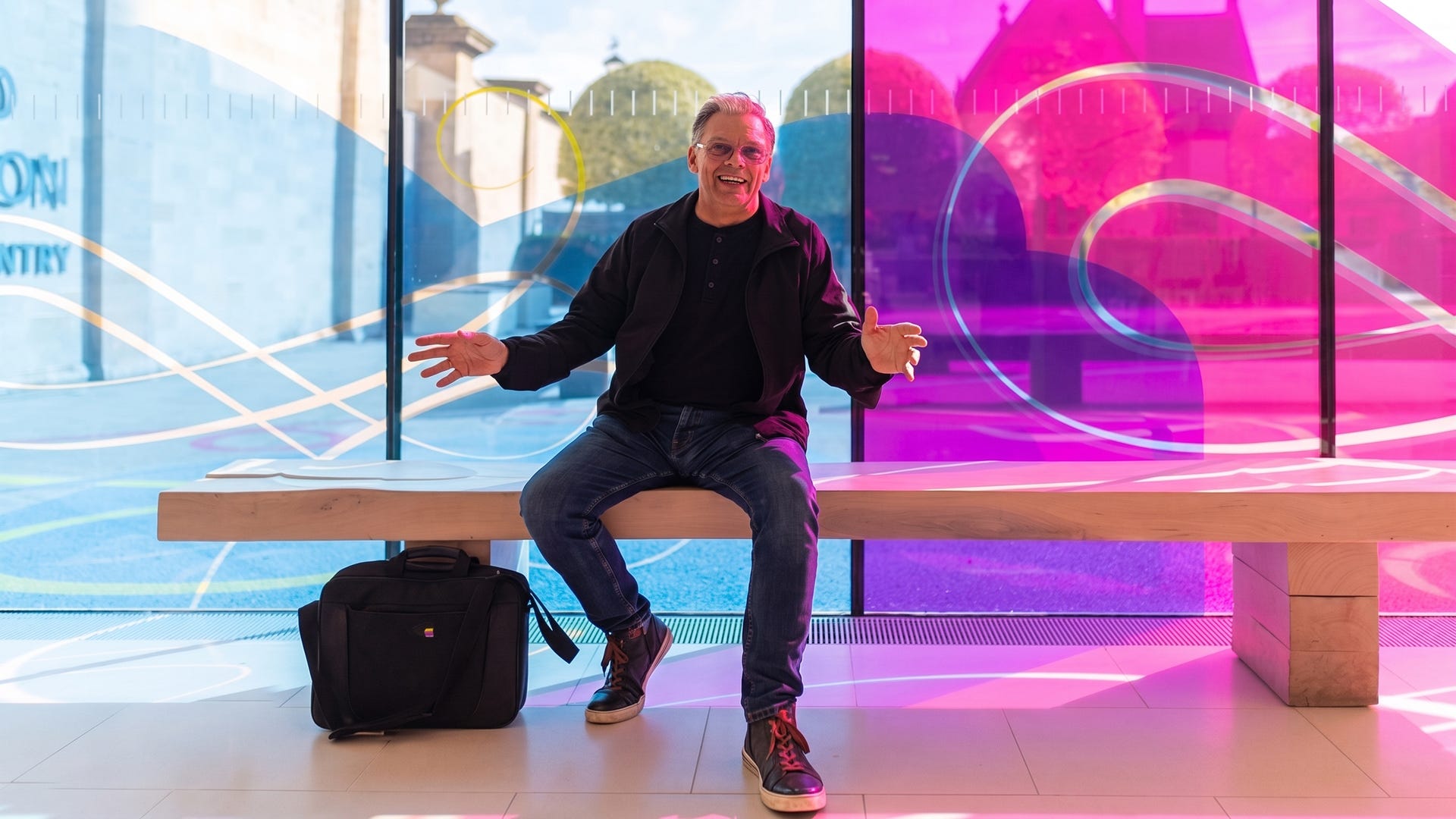
Andy and I sat in the gallery reception for a few moments. A kind of epilogue with the sunlight flooding in through coloured gels on the windows, scattering saturated rainbow colours across the floor.
Then spontaneously, Andy grabbed his camera. This was the rainbow effect I’d described taking place in Laurie Lovelace’s restored chapel in Houdini Window. ‘Click, click, click’ went the sound of the camera’s motor drive.
In the car park, I took a parting shot of Andy on my iPhone, which tried to imitate the satisfying click of its big brother. We agreed to reconvene in Adrian’s Portuguese café in a fortnight. A place to continue our chat about digital backlash and analogue print being cool again. And maybe time for some improvisation on God’s trumpet?
Driving home from the Welbeck estate, I passed through my father’s birthplace. Where he ran errands to the local Post Office - or at least that’s what he told us when his short term memory had gone. I guess my dad will forever be performing childhood errands in the Dukeries, along with my grandad Tom riding his pushbike, and Sally polishing Winifred’s silver.
Next time
Next time on the Design Intelligence Substack our special guest is User Centred Design Lead, Chris Leo. We’ll be talking about the future of AI in government and what it means for designers and the rest of us.
Anyway, ‘toodle-pip’ as we posh TV celebrities say. And remember...
You make magic real
- Laurie Lovelace
Digital magic available here!
Good design begins with good questions.
UX research finds them, design thinking answers them.
Links related to this substack:
Paul Fillingham Bio at Studio thinkamigo
Andy Tudor Portfolio
The Welbeck Estate - Discover the history, landscape and community
The Dukeries Wikipedia article
Portland
Dawn of the Unread When the dead go unread, there’s gonna be trouble
Houdini Window on Instagram